
Article
France’s Move from Windows to Linux: Why Digital Sovereignty Matters
France’s digital directorate has announced a move from Windows to Linux as ministries prepare wider plans to reduce dependence on non-European technology. We explore the costs, privacy concerns and lessons from the Gendarmerie’s earlier migration.

France’s Move from Windows to Linux: Why Digital Sovereignty Matters
By Binary-Tech Institute
Based on the French government’s announcement of 8 April 2026.
A government should be able to make independent decisions about the technology that runs its public services.
That means understanding its systems, controlling access to information and having a realistic way to change suppliers.
France’s announcement about moving towards Linux raises an important question: why has reducing
dependence on a single technology ecosystem taken so long?
Before answering that, we need to separate what France officially announced from some of the headlines surrounding it.
What did France actually announce?
On 8 April 2026, France’s Interministerial Digital Directorate, known as DINUM, announced that it would move its own workstations from Windows to Linux.
The government also required each ministry, including its operators, to prepare a plan by autumn 2026 to reduce dependence on technology from outside Europe. These plans cover:
Desktop systems.
Collaboration tools.
Antivirus software.
Artificial intelligence.
Databases.
Virtualisation.
Network equipment.
This is a broad policy direction. It does not mean every French government computer has already switched to Linux, or that every ministry has been instructed to install the same Linux distribution.
What about the 2.5 million computers and billion-euro cost?
Some reports describe a transition involving 2.5 million computers. However, the April announcement does not confirm that number as the scope of the Linux migration.
The figure of 2.5 million civil servants also appears in reporting about France’s separate plan to move government video meetings towards its Visio service. A target for collaboration software should not automatically be treated as a confirmed number of Linux installations.
Likewise, the official April announcement does not establish a €1.5–5 billion migration budget. Without a documented calculation or an official budget, that range should not be presented as fact.
There is still a serious economic question to discuss: how does the cost of changing compare with the long-term cost of remaining dependent?
The economic argument: look beyond licence fees
Moving a large organisation to Linux requires investment. Employees need training, applications need testing, and IT teams need time to rebuild support processes.
Some specialist software may require replacement. Some systems may need to continue running Windows during the transition.
A fair comparison should include:
Cost of changingCost of remainingMigration planning and testingContinuing licence and subscription paymentsEmployee and administrator trainingTraining for future product changesApplication replacement or adaptationMaintaining existing integrationsSupport and deployment workSupplier support and renewal costsTemporary operation of two environmentsFuture migration costs if dependence increasesOur assessment is that Linux’s financial value depends on how well the migration is managed. Removing a licence fee does not remove the need for skilled administrators, security updates, backups or support.
However, developing those capabilities can give an organisation more choice over who maintains its systems and how they develop.
That choice has value even before a migration produces measurable savings.
Digital sovereignty: who controls the technology?
Digital sovereignty means having meaningful control over the systems, information and suppliers on which an organisation depends.
For a government, this includes the ability to continue providing services when contracts, prices, technical requirements or international circumstances change.
Open-source software can support this goal because its licensing allows inspection, modification and redistribution under the applicable terms. It can make it easier to commission changes or engage another support provider.
But the argument needs precision.
It would be inaccurate to say governments can never inspect Microsoft source code. Microsoft’s Government Security Program provides participating governments and organisations with controlled, read-only access to selected source code, including Windows and Office.
The distinction is the extent of control. Permission to inspect selected code is different from the ability to modify, redistribute and independently maintain software under an open-source licence.
At Binary-Tech Institute, we believe that distinction deserves more attention than arguments about which desktop looks better.
Does Windows collect information?
Yes. Microsoft documents the diagnostic information Windows can send back to the company.
It says this information helps maintain security, investigate faults, improve reliability and develop its products. The information collected depends on the edition, configuration and diagnostic settings.
Microsoft also provides controls for organisations. Certain Enterprise, Education and Server editions support turning Windows diagnostic data off. Other applications and connected services have their own settings, so this does not mean every possible data connection is disabled.
The practical concern for a government is therefore more specific than “Windows collects data”.
It needs to establish what information leaves its systems, why it is collected, where it goes and whether those arrangements meet its requirements.
Installing Linux does not answer all those questions automatically. Applications, browsers, cloud services and remote administration tools still need careful assessment.
What does TikTok have to do with this?
The American debate over TikTok illustrates how governments assess technology through the ownership and control of a service.
In 2023, the US government issued instructions to remove TikTok from federal devices. That was a specific restriction involving government equipment, rather than a general ban on all Chinese software.
The position subsequently changed for TikTok USDS. A July 2026 US Department of Justice opinion concluded that the government-device prohibition no longer applied to that version under its revised ownership arrangements, leaving agencies discretion over its use.
The comparison has limits: Microsoft and TikTok present different products, relationships and risks.
Nevertheless, both debates demonstrate that a government’s assessment can extend beyond what an application does to who controls it and what dependencies it creates.
France’s concern about foreign technology should be understood in that wider context.
France has already taken this path with the Gendarmerie
France’s National Gendarmerie offers an important example of an earlier transition.
A European Commission case study records that the organisation began introducing open-source software in 2001 and decided in January 2008 to move new workstations to Ubuntu.
That places the Ubuntu migration’s beginnings around 18 years before the 2026 announcement. The Gendarmerie’s adapted Ubuntu environment became known as GendBuntu.
The case study describes a gradual approach: replacing applications and addressing compatibility issues before making the operating-system transition. It also records licence-cost savings and the importance of independence and flexibility.
The lesson is useful for any organisation considering a similar change: prepare the working environment before replacing the operating system.
Employees need their documents, applications and everyday processes to keep working.
Why has wider change taken so long?
Our view is that the biggest obstacle is accumulated dependence.
Over many years, organisations build applications, spreadsheets, identity systems, procurement arrangements and staff knowledge around existing software. Each decision can make a later migration more complicated.
There are also understandable operational concerns. A public service cannot stop functioning while an IT team experiments with replacements.
This creates a difficult balance: delaying a migration avoids immediate disruption, but may allow the dependency to grow.
A credible transition therefore needs:
An inventory of applications and dependencies.
Testing with representative users.
Training and accessible support.
Clear security responsibilities.
A phased rollout with recovery options.
Evidence that replacement systems meet operational needs.
The Gendarmerie’s experience shows why preparation matters. It does not prove that every ministry can repeat the same migration at the same cost.
Our perspective: independence requires practical skills
France’s move gives renewed attention to a long-standing issue: how much control should public institutions retain over the technology they rely on?
We believe open-source software deserves serious consideration wherever it can meet operational requirements. The strongest case combines transparency, supplier choice, maintainability and a tested ability to keep services running.
Those benefits depend on people who understand the systems. Governments and businesses need staff who can configure Linux, manage permissions, secure remote access, maintain services and troubleshoot problems.
For learners, this is a practical reason to build Linux skills. Understanding the technology gives you a better basis for evaluating both its strengths and its limitations.
The question “why did it take so long?” is worth asking. The next question is equally important: how can the transition be carried out well?
Sources and further reading
French government announcement: reducing non-European digital dependencies, 8 April 2026
European Commission case study: the French Gendarmerie’s Ubuntu migration
Microsoft: Windows diagnostic data and organisational controls
US Department of Justice: July 2026 opinion concerning TikTok USDS
Binary-tech.co.uk
Frequently Asked Questions
Keep reading
Related guides
More practical writing on networking, cybersecurity, and IT careers.
 Article
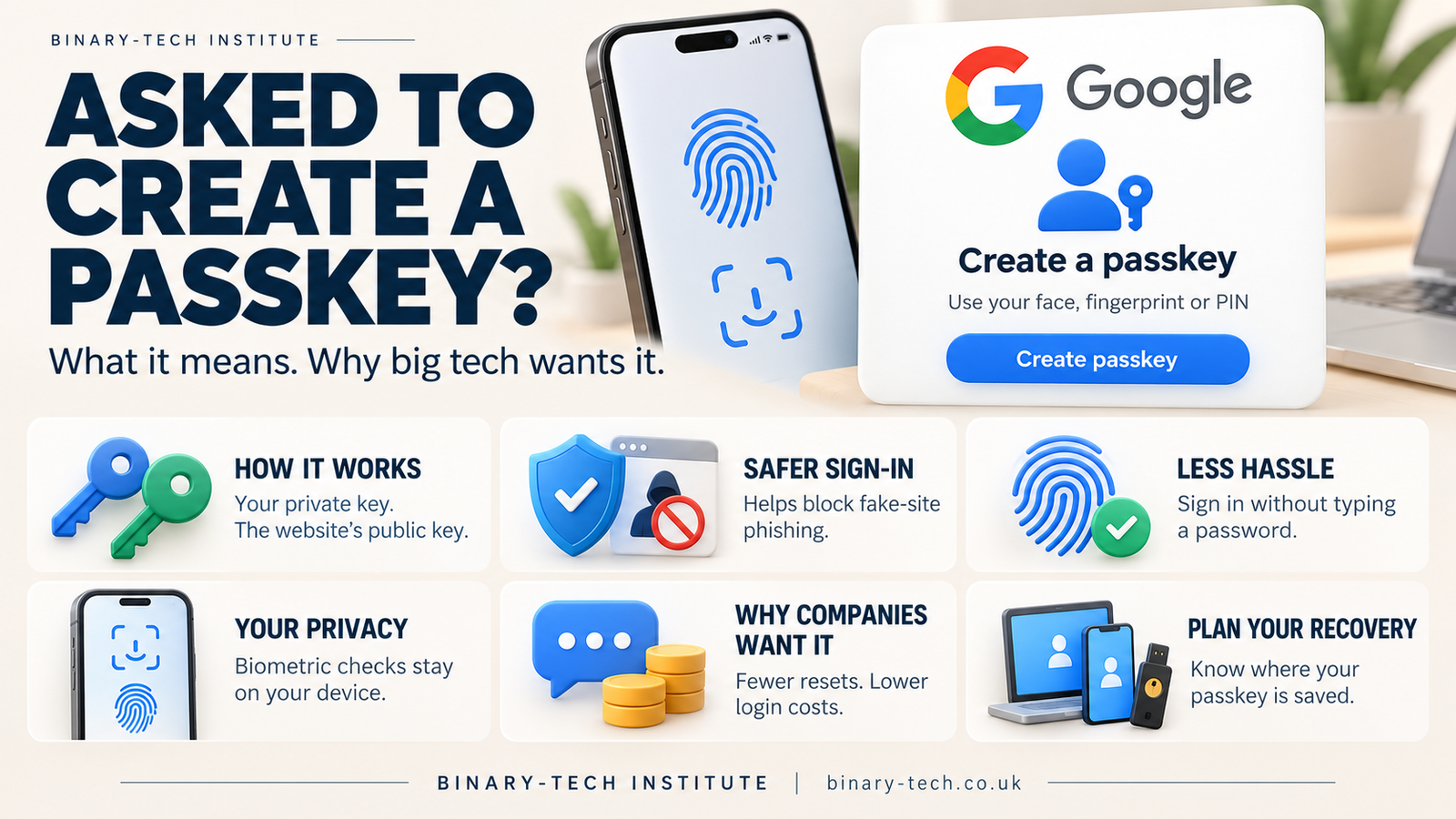
What Is a Passkey, and Why Are Websites Asking You to Create One?
Keep seeing “Create a passkey” when you sign in? Discover how passkeys work, why major tech companies are promoting them and what happens if you lose your phone.
Read article Article
When the Cloud Lost Power: How a London Outage Disrupted Revolut
A Google Cloud outage in London disrupted Revolut on 20 October 2026. Here is what happened, why recovery took time and what businesses can learn about resilience.
Read article Article
French Supermarket Cyberattack: How Hackers Targeted Fridges
A cyberattack on supermarket refrigeration systems in France shows how outdated, internet-connected equipment can disrupt real-world operations. Here’s what happened and the practical security lessons for businesses.
Read articleReady to learn with a mentor?
Turn what you just read into hands-on skill with a live Binary Tech cohort.